The “Green Deal” – personally proclaimed by Mrs von der Leyen in 2019 – promised great things: climate neutrality by 2050, emissions trading and billions in financial aid. The “Empowering Consumers” Directive (EmpCo, 2024/825) is another milestone in the fight against climate change. At least that’s how the Commission wants it to be understood. In addition to a ban on misleading green claims, the directive regulates comprehensive new information obligations for retailers. These are to be transposed into national law by March 2026 and apply from the end of September 2026. Specifically, the aim is to inform consumers about statutory warranty rights and voluntary manufacturer guarantees.
Current legal situation
Currently, the information obligations for consumer contracts for online retailers are based on Section 312d and Section 312j BGB in conjunction with Art. 246a EGBGB and for stationary retailers on Section 312a BGB in conjunction with Art. 246 EGBGB. This includes, for example, the essential characteristics of the goods and the identity of the trader. According to Art. 246a § 1 p. 1 nos. 11 and 12 EGBGB, information must already be provided on the existence of a statutory right of liability for defects and, if applicable, on the existence of a guarantee. Even if this multitude of mandatory information can be described as “information overkill”, which counteracts the purpose of a well-informed consumer, the jungle is now becoming even denser.
New mandatory graphics for warranties and guarantees
Art. 246a § 1 sentence 1 nos. 10 and 11 EGBGB become nos. 10 to 11c, Art. 246 para. 1 no. 5 EGBGB become nos. 5 to 5d. Now traders are to provide information about “the existence of a statutory guarantee for goods and its most important elements, including its minimum duration of two years, in a prominent manner” as well as “information that such a guarantee applies to these goods, its duration and a reference to the existence of the statutory guarantee”. If it is not clear on first reading what is meant and how this is to be implemented, the concerns can be ignored for the time being. Because – and this is the special thing about the innovation – the EU Commission has specified exactly how the information obligations are to be fulfilled in an implementing regulation ((EU) 2025/1960): by means of a “harmonised communication” and “harmonised labelling”.
Harmonised communication on warranty rights
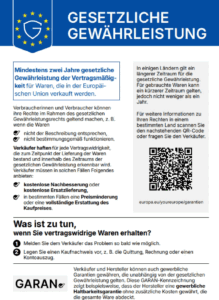

The “harmonised notice” must be used to inform consumers about the existence and scope of their rights and to prevent confusion with a commercial manufacturer’s guarantee. The presentation is not customisable: In stationary retail, it must be displayed in a “prominent manner”, e.g. in the checkout area. The minimum size is A4 (there are no upper limits). It may be in colour or black and white.
In online commerce, it is sufficient to place the “harmonised notice” as a general reminder in colour on the website. If the means of distance communication used to conclude the contract, such as a catalogue, does not provide sufficient space for the “harmonised notice” in A4, this can probably be dispensed with initially, as the notice will not be a mandatory requirement under Art. 246a § 3 EGBGB. Nevertheless, the trader must provide the consumer with this information in accordance with Section 312f (1) sentence 1 no. 1 and sentence 3 or (2) BGB on paper (in A4?) or another durable medium, for example by email. This is a disservice to environmental protection.
Harmonised labelling of product-related guarantees
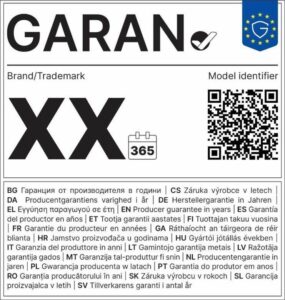



The “harmonised labelling” is intended to inform the consumer about the existence and scope of a possible manufacturer’s guarantee. This obligation can only be met if the guarantee (1) is offered for more than two years, (2) applies to the entire product without additional costs and (3) the manufacturer makes this information available to the seller. Why this obligation to provide information only applies from a guarantee of more than two years, even though a guarantee provides further protection due to the presumption rule under Section 443 (2) BGB, is just as unclear as the question of why retailers are obliged to provide information about manufacturer guarantees in this way at all. If it is a matter of sales-promoting facts, the seller’s own interest is certainly sufficient as an incentive. However, this was already the case under the current law, which is why the ECJ interprets the provision rather restrictively. Previously, the retailer only had to provide information about the details of a manufacturer’s guarantee if he advertised it in any way.
The “harmonised marking” is not to be understood as a general notice like the “harmonised communication”, but must be displayed prominently next to each product or directly on the packaging if there is a guarantee that meets the above requirements. Certain parts of the labelling must also be adapted to the product and the guarantee. Finally, these include the duration of the guarantee in years, the company and the model. It is not immediately clear how to proceed with a guarantee of two and a half years, for example.
In stationary retail, the labelling can be displayed in colour or black and white as long as it is at least 9.5 × 10 cm in size. Online, the “harmonised labelling” must be inserted in colour next to the product image. There is the option of a nested presentation. However, due to an amendment to Section 312j (2) BGB, the labelling must also be displayed “immediately before the consumer places his order”, i.e. in the shopping basket. For each individual product.
Possible ways out
You must comply with the requirements regarding “harmonised notification”. The effort is limited to a poster on the sales floor and a notice on the website, for example in the general terms and conditions.
In contrast, the interest in restricting the obligations with regard to “harmonised labelling” is significantly greater. You do not have to fulfil these obligations if the guarantee is offered for no longer than two years, is subject to a fee or certain conditions (e.g. registration or additional contract), only applies to certain individual parts and not to the entire product or if the manufacturer does not provide this information to the seller.
Conclusion
These information obligations must be complied with by 27 September 2026. Will there be fewer guarantees due to the high implementation effort, even though retailers have already pointed this out in their own interest? Will a major wave of warnings based on unfair competition regulations follow, as is often predicted in the case of difficult changes? That cannot yet be predicted. The only certainty is that the changes will neither bring any noticeable advantage for consumers, who are already overwhelmed with information, nor will they benefit environmental protection.