Smart TVs, fitness trackers, routers, baby monitors or apps on smartphones: almost every product today is connected or contains software. This also increases the risk of cyber-attacks. Until now, there have been virtually no binding EU requirements on the cyber security of such products. The Cyber Resilience Act (CRA) changes that. This article provides an initial overview: what does the CRA regulate, who does it apply to, and when does it come into force?
What is the Cyber Resilience Act?
The CRA is an EU regulation, specifically Regulation (EU) 2024/2847 on horizontal cybersecurity requirements for products with digital elements.
It was published in the Official Journal of the EU on 20 November 2024. As a regulation, it is directly applicable in all Member States; a German implementing law is therefore not required. The German legislature only regulates supplementary matters, such as which authorities are responsible. The CRA is the first piece of EU legislation to prescribe a minimum level of cybersecurity for virtually all connected devices on the EU market.
When does the CRA come into force?
The CRA does not come into force all at once, but in three stages:
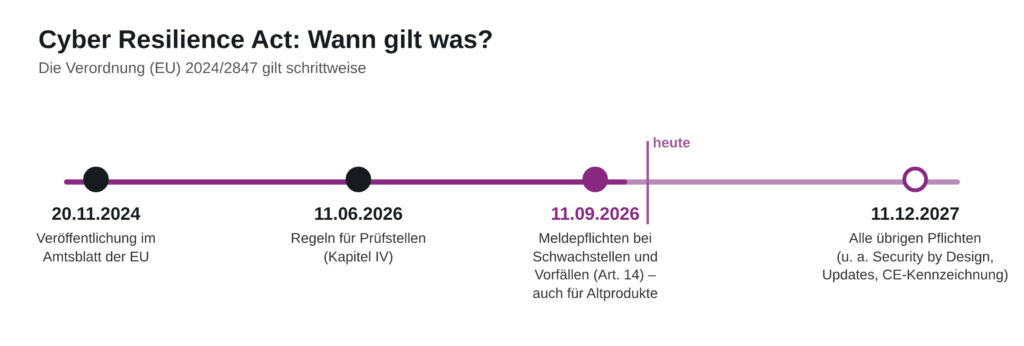
Products placed on the market before 11 December 2027 need only comply with the remaining requirements if they undergo significant changes after that date. The reporting obligations, however, also apply to such ‘existing products’.
Which products are affected?
The CRA covers ‘products with digital elements’. This refers to hardware and software that can connect, directly or indirectly, to another device or a network. This includes, for example, connected household appliances and toys, as well as operating systems, apps and industrial control systems. Exceptions apply where specific legislation is already in force, for example for medical devices, vehicles and the aviation sector. Pure cloud services are generally not covered by the CRA. Special rules apply to open-source software.
Not every product is treated in the same way
Most products are standard products. The basic requirements apply to them, and manufacturers can generally test and declare themselves that their product meets these requirements. Stricter rules apply to ‘important’ and ‘critical’ products listed in Annexes III and IV of the Regulation, such as password managers, firewalls or smart cards. For these, testing by an independent body or certification may be required. The European Commission has provided a more detailed technical description of these categories in Implementing Regulation (EU) 2025/2392.
What must manufacturers do?
The fundamental principle of the CRA is ‘security by design’: security must be built in at the development stage, rather than added as an afterthought. Manufacturers must, amongst other things:
assess and document the cybersecurity risks of their product; place products on the market without any known exploitable vulnerabilities; rectify vulnerabilities during the so-called support period and provide security updates; this period is generally at least five years, maintain a sort of ‘ingredients list’ of the software components used (known as a Software Bill of Materials, SBOM) and affix the CE marking to their products.
These obligations are linked to the established CE marking system.
Importers and distributors are also affected
The CRA is not aimed solely at manufacturers. Importers and distributors also have obligations: they may only sell products that meet the requirements and must, for example, check whether the CE marking is present. Anyone who markets a product under their own name or brand, or who makes significant modifications to it, is treated as a manufacturer themselves.
Reporting obligations in the event of security vulnerabilities
If a vulnerability in a product is actively exploited or a serious security incident occurs, manufacturers must report this. Reports are submitted via a central reporting platform operated by the European Union Agency for Cybersecurity (ENISA). The deadlines are tight: an early warning must be issued within 24 hours, followed by a more detailed report within 72 hours. This is followed by a final report. These obligations have been in force since 11 September 2026, and also apply to products sold before 11 December 2027.
What are the consequences of non-compliance?
Market surveillance authorities check whether products meet the requirements. They can have non-compliant products withdrawn from the market and impose fines. In the event of breaches of the essential requirements, fines of up to 15 million euros or 2.5 per cent of global annual turnover may be imposed, whichever is higher (Art. 64 CRA).
There are concessions for micro and small enterprises: if, for example, they fail to meet the 24-hour deadline for early warning, they will not face a fine for this. Furthermore, consumer organisations will be able to bring collective actions from 11 December 2027.
Outlook
The CRA makes cybersecurity a mandatory requirement for connected devices, comparable to traditional product safety. The reporting obligations have been in force since September 2026. By December 2027, companies should have clarified whether their products are affected, which category they fall into, and what processes they need to put in place for security updates and reporting. Starting early will help avoid bottlenecks just before the deadline.
Do you have any questions about the CRA or would you like to know whether your company is subject to its requirements? Please feel free to get in touch with us!