On 11 September 2026, it was that time again: the 7th IT Women Lawyers’ Day took place in Berlin – once more initiated and organised by Marlene Schreiber (HÄRTING Rechtsanwälte) and Nina Diercks (Diercks Law Firm). Lawyers, in-house counsel, data protection experts and tech experts gathered at the offices of HÄRTING Rechtsanwälte to discuss current practical issues relating to IT law.
/* ==========================================
IT JURISTINNENTAG 2026
========================================== */
.itj-2026 {
font-family: inherit;
color: inherit;
line-height: 1.7;
}
.itj-2026 h2 {
margin: 42px 0 16px;
font-size: 1.55em;
line-height: 1.35;
font-weight: 650;
}
.itj-2026 h3 {
margin: 34px 0 14px;
font-size: 1.18em;
line-height: 1.45;
font-weight: 650;
}
.itj-2026 p {
margin: 0 0 18px;
}
/* Sprungziele */
.itj-2026 [id] {
scroll-margin-top: 90px;
}
/* Die Sessionlinks werden per JavaScript positioniert. */
.itj-2026 .itj-session h3[id] {
scroll-margin-top: 0 !important;
}
/* ==========================================
INHALTSVERZEICHNIS
========================================== */
.itj-2026 .itj-nav {
background: #f8f7fa;
border: 1px solid #e9e4ef;
border-radius: 6px;
padding: 0 0 18px;
margin: 25px 0 38px;
overflow: hidden;
}
.itj-2026 .itj-nav-title {
display: block;
background: #7951a8;
color: #ffffff;
font-size: 1.06em;
font-weight: 700;
padding: 13px 22px;
margin: 0 0 17px;
line-height: 1.4;
}
.itj-2026 .itj-nav ul {
columns: 2;
column-gap: 28px;
margin: 0;
padding: 0 24px 0 42px;
}
.itj-2026 .itj-nav li {
margin: 0 0 9px;
break-inside: avoid;
}
.itj-2026 .itj-nav a {
color: #68418f;
text-decoration: none;
}
.itj-2026 .itj-nav a:hover {
text-decoration: underline;
}
/* ==========================================
ALLGEMEINE SESSIONÜBERSICHT
========================================== */
.itj-2026 .itj-details {
border: 1px solid #e4e1e8;
border-radius: 5px;
margin: 22px 0 18px;
padding: 0;
background: #faf9fb;
overflow: hidden;
}
.itj-2026 .itj-details summary {
cursor: pointer;
font-weight: 700;
color: #68418f;
padding: 17px 22px;
background: #f3f0f6;
line-height: 1.5;
}
.itj-2026 .itj-details ul {
margin: 18px 22px 18px 24px;
padding-left: 22px;
}
.itj-2026 .itj-details li {
margin-bottom: 11px;
}
/* ==========================================
HÄRTING-SESSIONÜBERSICHT
========================================== */
.itj-2026 .itj-session-overview {
background: #faf9fb;
border: 1px solid #e4e1e8;
border-radius: 5px;
margin: 24px 0 42px;
padding: 0;
overflow: hidden;
}
.itj-2026 .itj-session-overview summary {
cursor: pointer;
font-weight: 700;
color: #68418f;
padding: 17px 22px;
background: #f3f0f6;
line-height: 1.5;
}
.itj-2026 .itj-session-overview-content {
padding: 18px 24px;
}
.itj-2026 .itj-session-overview ol {
margin: 0;
padding-left: 21px;
}
.itj-2026 .itj-session-overview li {
margin: 0;
padding: 9px 0;
}
.itj-2026 .itj-session-overview li + li {
border-top: 1px solid #ece9ef;
}
.itj-2026 .itj-session-overview a {
color: #68418f;
text-decoration: none;
}
.itj-2026 .itj-session-overview a:hover {
text-decoration: underline;
}
/* ==========================================
EINZELNE HÄRTING-SESSIONS
========================================== */
.itj-2026 .itj-session {
padding-top: 5px;
margin-bottom: 30px;
}
.itj-2026 .itj-session + .itj-session {
border-top: 1px solid #e8e5ec;
padding-top: 20px;
}
/* ==========================================
BILDERCOLLAGE
========================================== */
.itj-2026 .itj-photo {
display: block;
max-width: 100%;
height: auto;
margin: 22px auto 35px;
}
/* ==========================================
MOBILE ANPASSUNG
========================================== */
@media (max-width: 767px) {
.itj-2026 [id] {
scroll-margin-top: 80px;
}
.itj-2026 .itj-nav ul {
columns: 1;
}
.itj-2026 .itj-nav {
padding: 0 0 16px;
}
.itj-2026 .itj-nav ul {
padding-right: 18px;
}
.itj-2026 .itj-session-overview-content {
padding: 15px 18px;
}
.itj-2026 h2 {
margin-top: 34px;
}
.itj-2026 h3 {
margin-top: 28px;
}
}
Tech Law Meets Female Empowerment
The IT Women Lawyers’ Day has now established itself as a permanent platform: a space where professional discourse, exchange and networking by and with female IT lawyers (w/d/m) take centre stage.
Anyone expecting rigid presentations and stilted monologues was quickly proven wrong. From the very first minute, the interactive Barcamp format created a dynamic atmosphere that was infectious.
Whether established partners, in-house counsel or tech specialists: the keynotes and sessions didn’t just pore over theoretical legal provisions, but discussed the very latest developments in the digital world. What inspired me most, alongside the technical topics, was the speakers’ openness about their experiences and personal perspectives from the field – including the hurdles that need to be overcome in day-to-day legal and tech work.
The 2026 sessions – practice-oriented deep dives
As every year, the IT Women Lawyers’ Day offered a wide range of practical topics relating to IT law.
The event opened and closed with keynote speeches by Carolin Loy (Head of the Digital Economy and Legal Issues relating to Artificial Intelligence Division and Press Spokesperson at the Bavarian State Office for Data Protection Supervision) and Dr Clarissa Freundorfer (former Group Representative for Deutsche Bahn AG in Baden-Württemberg), who shared insights into their career paths and the lessons they had learnt.
In addition to these fascinating keynote speeches, the participants organised the BarCamp with numerous engaging sessions. Topics discussed included:
All sessions and speakers
- Using AI in a legally compliant manner – Janina Winz LL.M. & Nicole Berenke Zanon CIPP/E
- ‘Lawyers’ responsibilities – right-wing populism, the rise of far-right forces’ – Stephanie Beyrich
- Transparency obligations, Article 50 of the AI Regulation – Marlene Schreiber
- AI in education & beyond age limits – Linda Schwarzlose, Caroline Glasmacher LL.M. & Janina Winz LL.M.
- Your keys, your coins? – Diana Nadeborn
- AI-generated client documents – Joselyne Ntikahavuye
- Transcription of video conferences – Carolin Loy
- GDPR, AI Regulation, Data Act, … What are the real risks? – Eljalill Tauschinsky
- Neurodiversity in the workplace – ADHD/autism/giftedness – Nina Diercks M.Litt.
- Shared Services: AV, JCA or separate responsibilities? – Dr Kristina Schreiber
- ‘Digital Sovereignty’ – Nicole Beranek Zanon CIPP/E
- Negotiation strategy for unfair contract terms with IT providers – Corinna Stubenvoll
- IT Security Law (NIS2, BSIG, CRA) – Paulina Pfeiffer
- Inventory-taking in an international group context: How do you get organised? (including shadow AI) – Dr Johanna Kirschnick & Nina Diercks M.Litt.
- AI risks in IT procurement – Kira Raguse
- Negotiation strategy for unfair contract terms with IT providers – Corinna Staubvoll
- A person who has ‘gone viral’ – use for advertising purposes (Sales Guy) – Cornelia Mattig
- Data transfers to the USA – Allaying clients’ and management’s fears – Didiane Avokpo
- Sex robots – legal and ethical implications – Iris Phan
- Is Your Story Holding You Back? – Liane Allmann
- Instructions from the employer to the employee in the collective agreement – Anna Cardillo
More information on the sessions led by our HÄRTING colleagues ↓
My highlight: discussions on an equal footing
The highlights were the many fruitful conversations on an equal footing and the open exchange with so many interesting people during the breaks and sessions. There were no barriers here between ‘experienced professionals’ and ‘newcomers’.
The professional and personal insights gained that day have not only broadened my horizons, but will certainly continue to shape me and my day-to-day work in IT law for quite some time to come. A huge thank you to the organisers and everyone involved for such an inspiring day!
Would you like to attend the next IT Women Lawyers’ Day in Hamburg?
Following the successful 7th IT Women Lawyers’ Day, we’re already looking forward to next year! Anyone interested can register their interest now with no obligation – simply send an email to events@haerting.de! Or sign up for our newsletter and follow Marlene Schreiber on LinkedIn to be informed in good time about the date and further details.
Highlights from the 7th IT Women Lawyers’ Day
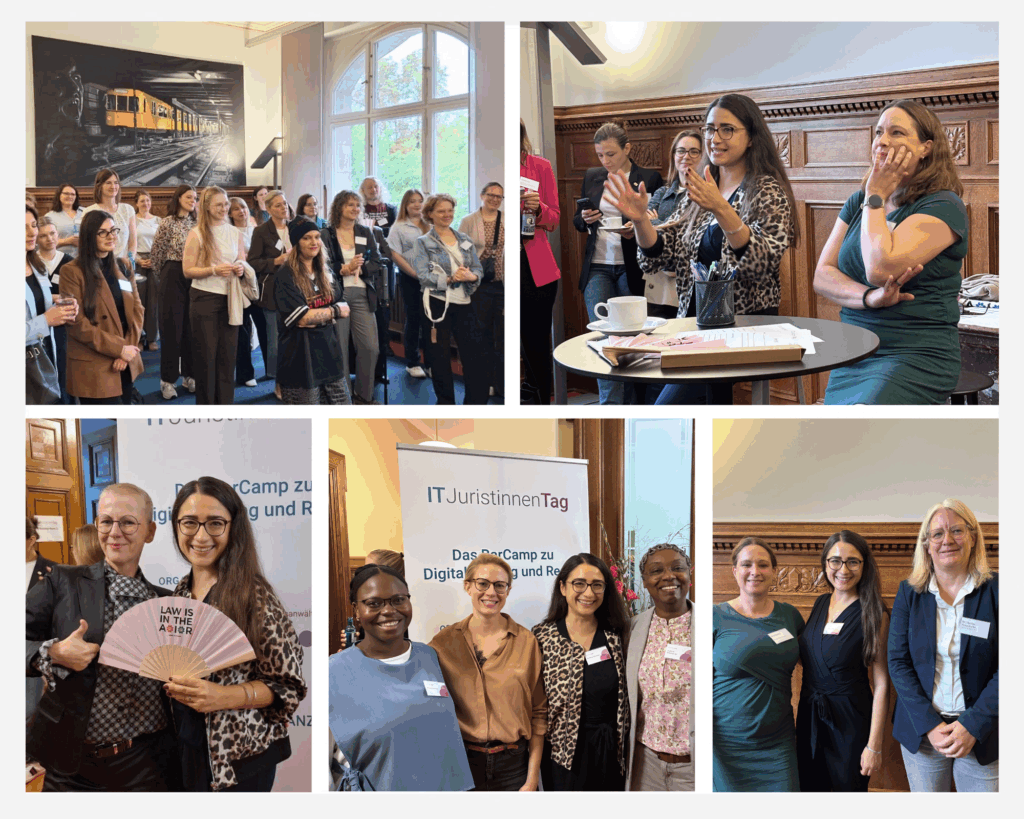
HÄRTING in attendance – insights from the sessions led by our HÄRTING colleagues
As every year, colleagues from HÄRTING were also represented with their own contributions. This time, Marlene Schreiber, Nicole Beranek Zanon, Cornelia Mattig, Corinna Staubvoll, Joselyne Ntikahavuye and Didiane Avokpo contributed to the sessions.
An overview of our HÄRTING sessions
- Transparency obligations, Article 50 of the AI Regulation – Marlene Schreiber
- Digital sovereignty – Nicole Beranek Zanon
- Viral content for advertising purposes – Cornelia Mattig
- AI-generated client documents – Joselyne Ntikahavuye
- Negotiation strategy for IT contracts – Corinna Staubvoll
- Data transfers to the USA – Didiane Avokpo
Transparency obligations, Article 50 of the AI Regulation – Marlene Schreiber
Since August 2026, most of the transparency obligations set out in Article 50 of the AI Regulation (‘AI Regulation’ or ‘AI Act’) have been in force. Companies are faced with the question of how to label AI-generated or manipulated content online in a legally compliant manner.
In addition to the issue of practical implementation, this session focused in particular on the topic of ‘deepfakes’. What specific content falls under the definition of a deepfake, and at what point must operators take action? The legal classification raises questions, particularly in digital commerce and amongst advertising and media agencies, and provides plenty of food for thought: does a photorealistic but entirely computer-generated model presenting clothing in an online shop already constitute a deepfake? How can the required transparency in shop design be achieved in such a way that consumers are clearly informed without disrupting the shopping experience? And how is the industry responding to the fact that the number of genuine deepfakes – and the associated infringements of personal rights – is rising rapidly, whilst tracking them down and removing them from the internet is extremely difficult to manage, both legally and technically?
The participants analysed the new regulatory frameworks and the guidelines published by the European Commission, and discussed how brands can reconcile compliance and design in e-commerce in future.
‘Digital Sovereignty’ – Nicole Beranek Zanon CIPP/E
Advancing digital sovereignty is bringing the issues of business continuity and IT resilience ever more sharply into focus. The discussion centred on the question of how public authorities and companies can maintain their operations should an external provider or its government activate a ‘kill switch’.
The participants analysed the current state of technological self-determination and highlighted which building blocks are still missing to ensure seamless protection of the entire infrastructure. To close these gaps, domestic innovation and financial commitments within Europe are primarily required. The entire panel urged that no more time be wasted and that alternative solutions be explored and implemented with immediate effect.
Person who went viral – use for advertising purposes (Sales Guy) – Cornelia Mattig
What happens when a private individual suddenly goes viral online overnight and companies use the images for their own marketing campaigns without asking? The session centred on the well-known ‘Sales Guy’ and addressed precisely this highly topical issue.
The discussion highlighted the legal frameworks at the intersection of copyright, trade mark and media law, and addressed key questions that concern both brand managers and those affected in equal measure:
What effective remedies are available to individuals whose personal rights are infringed by the unintended viral dissemination of their image? Under what conditions is retrospective or preventative commercial use permissible? How exactly is appropriate remuneration calculated for the use of such images for advertising purposes in the event of a dispute? The session participants used the opportunity to engage in an in-depth exchange of experiences and developed practical solutions for dealing with viral content in a legally compliant manner.
AI-generated client documents – Joselyne Ntikahavuye
The judiciary is sounding the alarm: current debates within the administrative courts show that unverified, page-long AI-generated pleadings and ‘hallucinated’ judgements are increasingly paralysing the courts. Unfortunately, the problem does not only affect the courts, but begins much earlier in law firm practice. In this session, participants addressed two aspects: dealing with clients on the one hand, and their own internal handling of AI-generated texts on the other.
Practical experience shows that well-intentioned, page-long AI-generated submissions from clients or in-house legal departments often have the opposite effect to that intended in terms of efficiency, and this raised key questions:
How can one convince clients and in-house management that AI-generated legal analyses, due to inaccuracies or misapplied legal principles, often result in nothing but costly extra work during the review process? How can a dialogue be established to ensure that AI is instead used in a targeted and meaningful way solely for the concise summarisation of facts and circumstances? And how is the legal profession responding internally? The participants engaged in an in-depth exchange on communication strategies and best practices to ensure that client work in the AI era is both legally sound and efficient.
Negotiation strategy for problematic contract clauses with IT providers – Corinna Staubvoll
This is a pressing issue for many colleagues in practice: in contract negotiations with large IT providers, one all too often encounters rigid clauses and a firm “That is non-negotiable”. This session demonstrated how to successfully overcome such deadlocks in the negotiation process without having to compromise one’s own legal position. The direct exchange of views was particularly valuable, as both the provider and client sides were represented in the discussion.
The discussion made it clear that stubborn insistence rarely achieves the desired outcome, and raised key questions for successful negotiation:
How do you break down a dogmatic ‘no’ from the other side and, through targeted, strategic questioning, achieve a genuine understanding of your own risk position? How do you move away from aggression and towards a sort of ‘coaching approach’? And how do you manage to remain completely authentic despite using tactical manoeuvres?
Data transfers to the US – Allaying the fears of clients and senior management – Didiane Avokpo
The recent ruling by the US Supreme Court (Trump v. Slaughter) has shaken the foundations of the EU-US Data Privacy Framework (DPF) and is causing great uncertainty in boardrooms. In this session, participants addressed the key question of how to allay the fears of clients and senior management in these turbulent times.
The session highlighted just how strikingly different the approaches of the various stakeholders to the topic of Transfer Impact Assessments (TIAs) are, and raised fundamental practical questions:
How do in-house lawyers manage damage control? What liability risks must external data protection officers now proactively protect their clients from? And what role do the new data centres in Europe play in this context – are US tech giants actually ‘buying’ legal certainty for European data, or does the risk of US access still remain? The participants used the session to engage in an in-depth debate on pragmatic contingency plans for transatlantic data flows.
(function () {
“use strict”;
var sessionIds = [
“session-marlene”,
“session-nicole”,
“session-cornelia”,
“session-joselyne”,
“session-corinna”,
“session-didiane”
];
function scrollToSession(id) {
var target = document.getElementById(id);
if (!target) return;
var desktop = window.innerWidth >= 768;
// Gewünschte Position der Überschrift:
// Desktop: 90 px unter dem oberen Fensterrand
// Mobil: 80 px unter dem oberen Fensterrand
var offset = desktop ? 90 : 80;
var position =
target.getBoundingClientRect().top +
window.pageYOffset –
offset;
window.scrollTo({
top: Math.max(0, position),
behavior: “instant”
});
}
document.addEventListener(
“click”,
function (event) {
var link = event.target.closest(‘a[href^=”#session-“]’);
if (!link) return;
var id = link.getAttribute(“href”).substring(1);
if (!sessionIds.includes(id)) return;
if (!document.getElementById(id)) return;
event.preventDefault();
event.stopImmediatePropagation();
scrollToSession(id);
// Erneute Positionierung, falls das
// WordPress-Theme selbst scrollt.
setTimeout(function () {
scrollToSession(id);
}, 150);
setTimeout(function () {
scrollToSession(id);
}, 450);
},
true
);
})();