The EU Directive on platform work is intended to make it easier to determine employment status and to make the use of algorithmic systems more transparent. What changes platform companies can expect, and why they should review their contract models and processes now.
What the Directive means for platform workers and platform companies
Millions of people now offer their labour via digital platforms, often under conditions where the line between self-employment and employment is blurred. With Directive (EU) 2024/2831, European legislation is now making a far-reaching attempt to reorganise the labour law framework governing platform work and, in particular, to provide greater clarity and protection regarding employment status and algorithmic management.
In 2022, the number of people working via digital platforms in the EU was estimated at around 28 million; a rise to 43 million has been forecast for 2025. A study published in October 2026 by the German Economic Institute puts the number of platform workers in Germany at around 3.9 million.
On 23 October 2024, Directive (EU) 2024/2831 on improving working conditions in platform work was adopted. Member States must transpose it into national law by 2 December 2026.
Implementation in Germany: the clock is ticking
The Directive obliges Member States to transpose the provisions into national law within the specified timeframe. For private platform companies, the new obligations generally arise as a result of national transposition.
Germany is under time pressure in this regard: the transposition deadline is 2 December 2026. The Federal Ministry of Labour and Social Affairs is working on the transposition. It remains to be seen how the new requirements will be specifically shaped in German law.
What is platform work?
Platform work is a form of employment in which individuals use a ‘digital work platform’ to connect with others in order to solve specific problems or provide specific services in return for payment. The best-known examples are delivery and mobility services, but platform work exists in many other sectors (e.g. domestic services or care work). Article 2(1)(b) of the Directive makes it clear that, for the purposes of classifying work as platform work, it is irrelevant whether the contractual relationship established via the platform is concluded directly between the person performing the platform work and the recipient of the service, or whether an intermediary is involved.
A ‘digital labour platform’ within the meaning of the Platform Work Directive, as defined in Article 2(1)(a), exists only if a natural or legal person provides a service that meets the following four criteria:
- it is provided, at least in part, remotely by electronic means (e.g. via a website or app),
- it is provided at the request of a person receiving the service,
- a necessary and essential component of the service is the organisation of work carried out by individuals in return for remuneration (regardless of whether this work is carried out online or at a specific location),
- it involves the use of automated monitoring systems or automated decision-making systems.
Automated monitoring systems are electronic systems used by a platform to monitor, control or evaluate the work of its platform workers, for example through GPS tracking, the recording of working hours or customer reviews. Automated decision-making systems are electronic systems that make or prepare decisions with tangible consequences for platform workers. This includes, for example, which person is assigned which job, how much they earn for it, what their working hours are, or when their account is suspended. The systems therefore take on tasks that would otherwise be carried out by supervisors.
Key provisions of the EU Directive
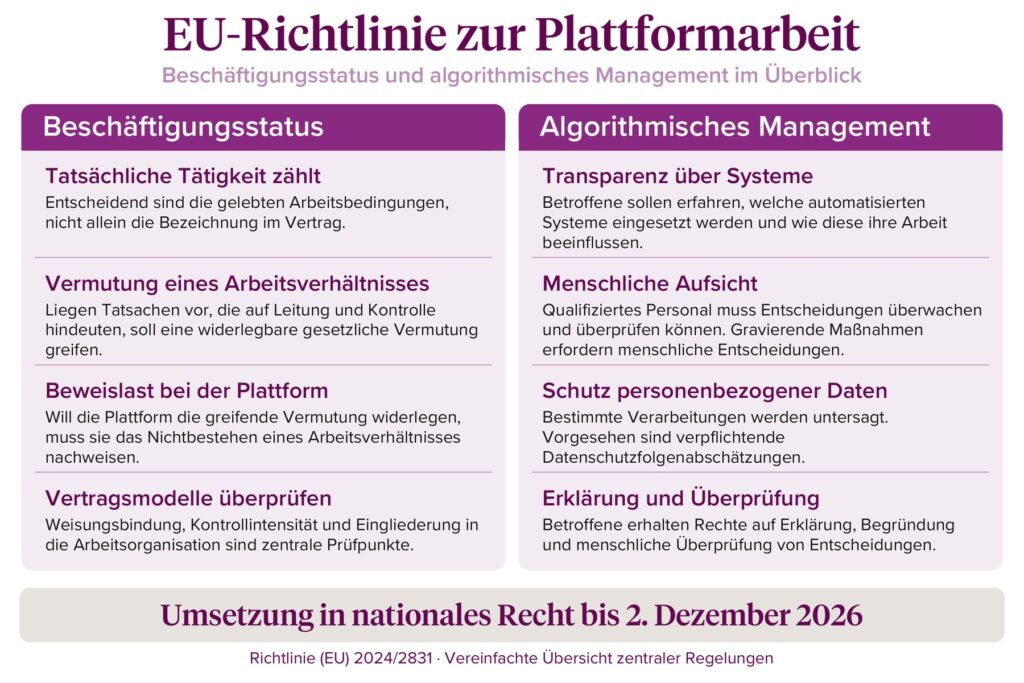
The Directive aims to improve the working conditions of platform workers and to protect their personal data (Recital 16). It contains the following key provisions:
Correct classification of status and protection against bogus self-employment
The legal classification of platform work has already been the subject of numerous court cases. The focus is regularly on the distinction between employment and self-employment.
The contractual designation as self-employment is not decisive for the legal classification. Rather, the actual circumstances of the work are decisive. In particular, if the person concerned is subject to instructions and personally dependent, an employment relationship may exist despite the agreed status of self-employment (so-called ‘bogus self-employment’).
The legal classification has significant practical consequences: if a person is incorrectly classified as self-employed, they may be denied entitlements to the minimum wage, paid holiday and continued payment of wages, as well as protection under social security law. For the platform company, this may result in particular in back payments of wages and social security contributions, as well as other legal consequences where applicable.
The EU Directive aims to remove legal uncertainty regarding the determination of status by providing for a rebuttable legal presumption of an employment relationship. If the conditions laid down under EU law – and, in future, under national law – are met, there is a rebuttable presumption that an employment relationship exists.
Furthermore, the Directive provides for a reversal of the burden of proof: if the conditions for the presumption of employment are met, it is the responsibility and duty of the platform to rebut this presumption in the event of a dispute, in accordance with the national law that will apply in future.
Until the Directive is transposed into German law, the assessment of status will, in principle, continue to be governed by the current German legal framework. Under this framework, the party invoking the existence of an employment relationship generally bears the burden of presentation and proof regarding the relevant facts. Should the Directive not be transposed within the prescribed time limit, the courts must, by way of an interpretation consistent with European law, interpret national law as far as possible in the light of the wording and purpose of the Directive.
Regulation of algorithmic management
The Directive also contains provisions governing the use of automated monitoring and decision-making systems in platform work. The focus is, in particular, on transparency, human oversight and the protection of data subjects against adverse automated decisions.
Key provisions of the Directive are:
- A ban on certain types of processing, e.g. processing personal data relating to the emotional state or private conversations of platform workers, or to predict the exercise of fundamental rights such as freedom of association (Art. 7).
- An obligation to carry out a data protection impact assessment in accordance with Article 35 of the GDPR (Article 8).
- Extended transparency obligations towards platform workers, their representatives (e.g. employee representative bodies or trade unions), and at the request of national authorities (Article 9(1) to (5)).
- The right of platform workers to take their data (e.g. ratings) with them when switching platforms (Article 9(6)).
- Obligation to ensure human oversight, the requirement for human decision-making in the case of account suspensions and similarly serious measures, as well as a right for platform workers to receive an explanation, written justification and human review of automated decisions (Articles 10 and 11).
From an employment law perspective, the following provisions are particularly relevant:
- Right to terminate or suspend accounts: The Directive restricts the use of automated systems in decisions that significantly affect platform workers. For the purposes of a specific assessment, a distinction must be made between the allocation of tasks, evaluation and monitoring, remuneration, the restriction of access to the platform, and the termination of an employment relationship.
- Right to issue instructions and directions: this raises the question of the extent to which an algorithm may dictate the work without constituting impermissible total surveillance. Furthermore, the specific assessment depends on the degree of subordination to instructions, the intensity of monitoring and integration into an external work organisation.
- Works Constitution Act (collective labour law): Depending on the specific arrangements, the works council’s rights to participation and co-determination, in particular under Section 87(1)(6) of the Works Constitution Act (BetrVG), may be affected. One of the prerequisites is that the technical equipment is designed or suitable for monitoring the behaviour or performance of platform workers.
Transparency towards authorities and representative bodies
The Directive also provides that digital labour platforms must report the work carried out by platform workers to the competent authorities of the Member State in which the work is performed (Article 16).
Digital labour platforms are also to be required to provide national authorities and the representatives of platform workers with key information on platform work for each Member State in which work is carried out via the platform. This includes, amongst other things, the number of active workers by activity level and contractual or employment status, and the average duration of activity. The information must be updated at least every six months; in the case of SMEs, the Member State may provide for an annual cycle. Furthermore, authorities and representatives should be able to request additional explanations (Art. 17).
Implications for practice
Platform companies should review their contractual and deployment models at an early stage to determine whether the contractual classification of platform workers corresponds to the actual nature of the work. Particular attention should be paid to circumstances that indicate direction or control by the platform. This is because, in such cases, the legal presumption that an employment relationship exists may apply in future; it will then be incumbent on the platform company to rebut this presumption. Many companies are therefore likely to face a considerable need for review and, where necessary, adjustment even before the German implementing legislation comes into force.
In addition, the algorithmic systems in use, as well as existing decision-making and control processes, must be reviewed to ensure they comply with the new requirements. In particular, qualified staff must be available to provide human oversight and to review decisions.
Breaches could have significant financial consequences. The Directive assigns the monitoring of the requirements relating to algorithmic management (Articles 7 to 11) to the data protection supervisory authorities and adopts the fine framework set out in Article 83(5) of the GDPR (Article 24(1)). The Uber case illustrates just how high fines imposed by data protection supervisory authorities can be under current law: the Dutch Data Protection Authority imposed a fine of around 825 million euros, partly due to the automated suspension of drivers’ accounts without human intervention and without informing the individuals concerned. At the time of publication of this article, the imposition of the fine is not yet final.
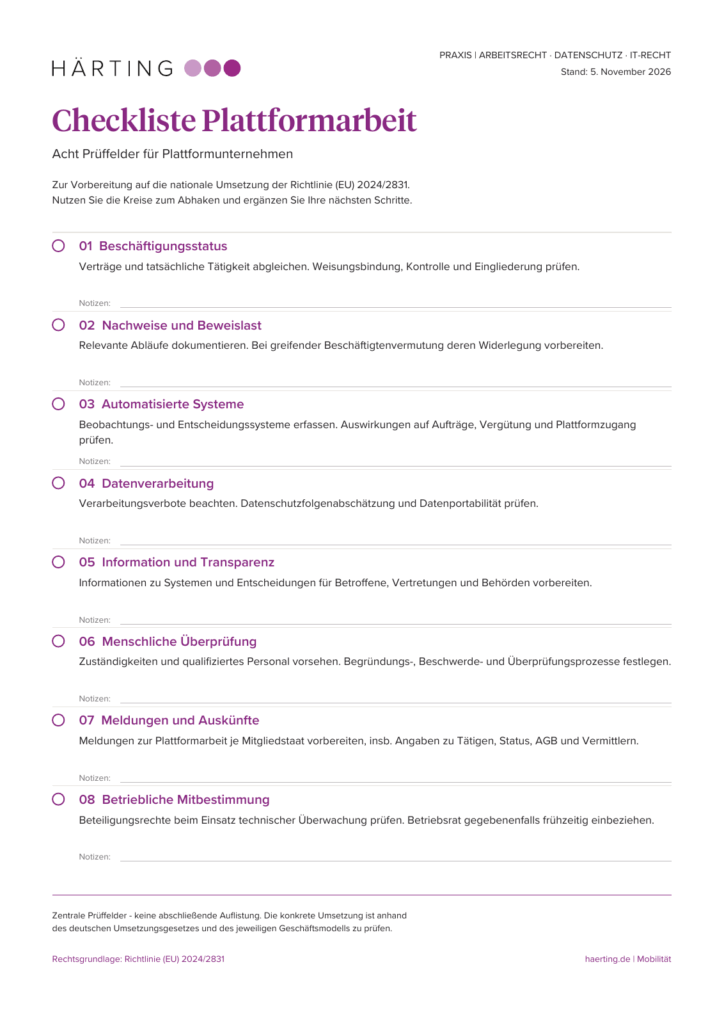
Checklist for platform companies
Eight key areas to review in preparation for national implementation: our checklist brings together the most important practical starting points and provides space for your own notes.
A4 PDF to save and print
Conclusion
The Directive establishes, for the first time, a uniform EU-wide framework for key issues relating to platform work. In particular, it is intended to facilitate the correct determination of employment status whilst ensuring greater transparency, human oversight and data protection when algorithmic systems are used. It therefore presents far-reaching changes not only for platform workers but also for platform companies. The extent to which these changes will impact practice depends largely on the wording of the German implementing legislation. In particular, it remains to be seen whether Germany will merely implement the European minimum requirements or introduce additional protection and compliance requirements that go beyond them.
One thing is already clear: platform companies should use the time remaining to review their contract models, internal processes and algorithmic systems at an early stage to identify any need for adaptation. HÄRTING Rechtsanwälte supports platform companies in this process and provides cross-team advice on both IT and employment law.
Find out more about our advisory services for digital mobility platforms and companies in the mobility sector.