Series of articles on Regulation 2024/900 on the transparency and targeting of political advertising (TTPW)
Regulation 2024/900 on the transparency and targeting of political advertising (TTPW) has been in force since 10 October 2025. Through the TTPW, the European legislator aims to prevent the dishonest influencing of political decisions. The rationale behind the TTPW is undoubtedly an important one: political advertising interferes with legislative processes and electoral decisions. Where this involves disinformation, it can be highly problematic. However, the TTPW goes further and places political advertising as such under general suspicion. This regulatory flaw must always be borne in mind when applying the TTPW.
The provisions of the TTPW are complex. This is likely one of the reasons why the Commission has published guidance on the implementation of the TTPW. Similar to other European regulatory frameworks, the TTPW also provides for sanctions which apply in addition to other sanction regimes, in particular those of the GDPR.
The national data protection supervisory authorities are responsible for enforcing the TTPW. Presumably due to its proximity to ‘political Berlin’, the Data Protection Conference has agreed that, in Germany, the Berlin supervisory authority will take the lead in dealing with the TTPW. The first proceedings are already underway, including those in which we are involved.
In this series of articles, we will present selected legal issues relating to the TTPW and provide initial answers to the numerous legal questions arising from the application of the Regulation.
Part 1: What does the TTPW regulate, and to whom does the regulation apply?
Scope of the TTPW
The TTPW primarily regulates requirements relating to the dissemination of political advertising, but not the political advertising itself. The lawfulness of the content of a political advertisement is to be determined exclusively by other provisions, but not by the TTPW (see Article 2(2)). Consequently, other regulations remain applicable alongside the TTPW, such as, in particular, data protection provisions and provisions relating to services and digital services.
A key prerequisite for the obligation to comply with the provisions of the TTPW is the existence of ‘political advertising’ or a ‘political advert’.
What is political advertising?
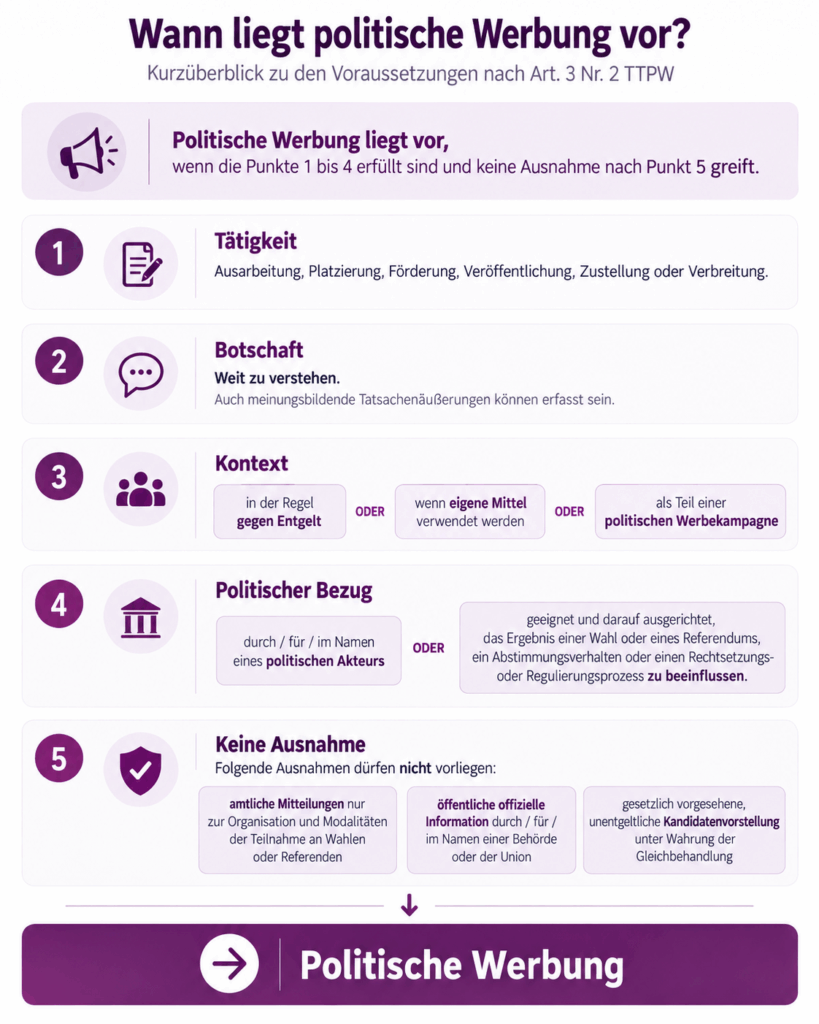
The central concept of the TTPW is ‘political advertising’. This term must be distinguished from the concept of sales-promoting advertising, which is rooted in the law on unfair competition. The TTPW uses a distinct term and defines it in Article 3(2) in a rather convoluted manner via a multitude of sub-terms, each of which in turn requires its own definition. (The highlighted terms will be examined in more detail below):
‘Political advertising’ [is] the drafting, placement, promotion, publication, delivery or dissemination of a message by any means, which is generally carried out in return for payment or as part of internal activities or as part of a political advertising campaign,
(a) by or for a political actor or on their behalf, unless it is of a purely private or purely commercial nature; or
(b) which is capable of, and intended to, influence the outcome of an election or a referendum, voting behaviour, or a legislative or regulatory process at Union level or at national, regional or local level;
and which does not include:
- communications from official sources of the Member States or the Union relating exclusively to the organisation and arrangements for participation in elections or referendums, including the announcement of candidacies or referendum proposals, or the promotion of participation in elections or referendums;
- public communications intended to officially inform the public by, for or on behalf of a public authority of a Member State or by, for or on behalf of the Union, including by, by, for or on behalf of members of a Member State’s government, provided that such communications are not likely to, and are not intended to, influence the outcome of an election or a referendum, voting behaviour or a legislative or regulatory process; and
- the presentation of candidates in certain public spaces or in the media, which is expressly provided for by law and takes place free of charge whilst ensuring equal treatment of candidates.”
Message
A ‘message’ is to be understood as any opinion-forming statement, irrespective of whether the opinion is one’s own or that of another. Statements of fact are also messages in the legal sense.
Remuneration
‘Remuneration’ means any consideration, whether direct or indirect, of a financial nature or in kind. If the preparation, placement, promotion, publication, delivery or dissemination of political advertising in any way constitutes a (commercial) exchange of give-and-take, it is in return for remuneration. This interpretation is confirmed by Recital 1 of the Regulation, which states that, in addition to payment, other forms such as payments in kind are also sufficient to constitute remuneration. However, drawing the line can, of course, be difficult in individual cases.
Internal activity or part of a political advertising campaign
As an alternative to consideration, the fulfilment of either of the following two conditions is sufficient: ‘within the scope of internal activities’ and ‘as part of a political advertising campaign’. These conditions are also mutually exclusive and stand in alternative relationship to one another and to the requirement of remuneration. This means that only one of the three conditions needs to be met. Both terms require further explanation.
A political advertising campaign is defined in Article 3(7): several political advertisements constitute a political advertising campaign if they are intrinsically linked and are jointly devised or financed under a single contract. Advertising campaigns reach more people than individual advertisements. Therefore, particular transparency is to be ensured in this regard (recitals 57 and 64).
‘In-house activity’ is the counterpart to a publicity campaign. The advertising campaign is handled by an external service provider. The internal activity does not involve the use of external parties. Examples of an internal activity include, for instance, printing and distributing leaflets oneself or party members sharing a party’s political content via social media.
Who is a political actor?
Another key term in the TTPW is the ‘political actor’. In addition to the criteria already discussed, this is also an alternative characteristic alongside the ‘influence alternative’, which is set out below. Article 3(4) contains an exhaustive list of possible political actors. Only those individuals and organisations that fall under one of the categories listed there are political actors. Most of the organisations listed are likely to be self-explanatory:
- parties (lit. a);
- (Party) alliances, i.e. primarily associations of political parties (lit. b);
- European parties (lit. c);
- candidates for and holders of political office (lit. d and e);
- organisations established solely for the purpose of influencing the outcome of an election or a referendum (lit. f); and
- persons who support one of the political actors in achieving their political objectives, such as youth organisations and, where applicable, political foundations (lit. g; Recital 33).
In practice, there is controversy surrounding, amongst other things, the ‘organisations established solely for the purpose of influencing the outcome of an election or a referendum (lit. f)’ referred to in subparagraph (f). This primarily refers to actors that fall below the threshold of a political party, e.g. because they are not intended to exist as a permanent organisation or because they do not take part in elections. Also covered by subparagraph (f) are actors that do not have an organisational structure comparable to that of a political party. Influencers or blog operators are unlikely to be classified as ‘organisations’ within the meaning of subparagraph (f). However, a different assessment may apply if such actors are so closely integrated into an organisation that they must be regarded as part of it. Whether point (f) also covers cases in which a website is operated for or on behalf of a political organisation in return for payment requires examination on a case-by-case basis.
What is meant by ‘suitability’ and ‘orientation’?
As an alternative to a message from a political actor, it is also sufficient if the message is ‘suitable and designed’ to influence a vote or legislative process. In this context, suitability is defined as an objective criterion, whilst orientation is defined as a subjective or functional criterion.
Whilst both ‘suitability’ and ‘orientation’ are to be determined on the basis of objective circumstances, one must not infer the existence of one from the existence of the other. Only together do they allow a political message to be distinguished from a private or commercial (or other) message (Explanatory Memorandum 23).
The following, for example, may be used as criteria for determining whether such a substantial link exists between the message and the attempt to influence:
- Overlap with a specific legislative process to which the message relates (e.g. during readings in the Bundestag).
- The means by which the message is disseminated (e.g. funding from a specific grant scheme for political projects; a guest article in a party newspaper).
- The language in which the message is presented (an Instagram post in Sorbian is neither intended nor likely to influence the election to the Bremen Parliament).
- Who the message is aimed at (e.g. family members or existing customers – in which case it is unlikely to constitute political advertising).
- The tone of the message (e.g. a message referring to a legislative process on climate policy and critically addressing a political party’s position is more likely to be suitable for and aimed at influencing voters)
- Of course, the content of the message may also suggest its political nature.
In determining whether influence is exerted, the point in time of dissemination must be taken into account. If the criteria only become apparent later, this is irrelevant to the political nature of the message. This also applies if the dissemination is still ongoing. A message does not ‘gradually evolve’ into political advertising. A different approach may apply in the case of continuously renewed dissemination.
What is a political advertisement?
A political advertisement is political advertising communicated to the public. Political advertising becomes a political advertisement as soon as it is published, delivered or disseminated.
How does political advertising differ from other forms of advertising?
‘Advertising’ in an economic context is defined as any statement made in the course of trade, business, craft or the liberal professions, with the aim of promoting the sale of goods or the provision of services, including immovable property, rights and obligations. These criteria cannot be applied in the same way to political advertising.
Whilst (other) advertising is protected because it is an expression of the right to run a business, the dissemination of political content is an expression of freedom of expression. Although under European law, commercial advertising may also fall under the scope of freedom of expression, these two fundamental rights must be considered separately. Calls to vote, as a core form of political expression, are not subject to the same level of regulation as other advertising messages, which may, by their very nature, be perceived as intrusive.
Are there any legally defined exceptions to the obligations of TTPWs?
Yes, but only to a very limited extent. Official notices, announcements or other forms of public communication by public authorities, for example, do not constitute political advertising.
Furthermore, pure expressions of opinion and editorial content (press articles) are generally not regarded as political advertising, unless remuneration is paid for them. If podcasts or social media posts containing editorial content are produced for remuneration, each case must be considered individually to determine whether direct and measurable remuneration is involved. Only then does it constitute political advertising within the meaning of the TTPW.
Part 2 of this series of articles will follow next week.